СТАТУС ИГРЫ
C
Да, стоит играть
Серьёзных проблем нет, минусы описаны ниже
Почему оценка C: мнения разделились: недовольных почти столько же, сколько довольных
Данные SteamОбновлено 4 часа назад
Серьёзных проблем нет, минусы описаны ниже
Почему оценка C: мнения разделились: недовольных почти столько же, сколько довольных
Нет игроков онлайн в Steam - это не определяет готовность одиночного режима · последнее известное значение, ещё не обновлено
789 дней назад
Нет отзывов за последние 30 дн.
Русского нет · всего 3 языка
259 руб.
Сравним с вашим ПК и прикинем FPS
Подробных отзывов на русском мало - добавлены отзывы на других языках.
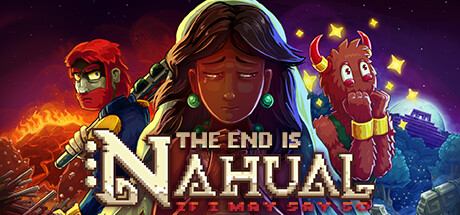
The world is broken. The gods have vanished without explanation, powerful nahual beings have left destruction behind them, and somehow, in the middle of all that chaos, life still finds strange ways to move forward. Some people seek purpose. Others seek revenge. Some simply wish they had started the day with a decent breakfast. The end is nahual: If I may say so presents itself as an adventure filled with absurd humor, existential questions, strange encounters, and moments that intentionally blur the line between comedy and deeper reflection. At first glance, it appears chaotic and almost nonsensical. The game openly jokes about being “about nothing,” but beneath that intentionally playful presentation lies something far stranger. It builds a world where emptiness itself becomes part of the conversation. The experience constantly challenges players to think about existence in unusual ways. Space, absence, meaning, and identity become recurring ideas woven directly into both the story and the humor. The game plays with philosophical concepts while refusing to treat them too seriously. It asks uncomfortable questions before immediately undermining itself with absurd comedy. It invites reflection before suddenly pivoting into a joke about salsa, empty space, or the possibility that reality itself is somehow improvising. The narrative follows unusual figures trying to survive within a fractured world shaped by supernatural conflict and uncertainty. Among them is a witch whose failed attempt to eliminate the Nahual Queen sets larger events into motion. Failure becomes an oddly important theme throughout the experience. Mistakes matter. Regret matters. The strange people navigating this collapsing world carry their own motivations, fears, and desires forward even when circumstances seem hopeless. One central figure is Sammael, a Nahual princess who abandoned her original identity in search of security and self-preservation. She exists somewhere between vulnerability and destruction. Part of her seeks safety. Another part moves toward something far more dangerous. Humanity itself becomes a complicated target of frustration and judgment, creating tension that extends beyond simple conflict. Alongside her stands Jacob, another presence moving through this surreal narrative landscape where absurdity and seriousness constantly collide. The game positions players less as traditional heroes and more as participants enabling these stories to unfold. Characters speak directly, ask questions, challenge expectations, and occasionally seem almost aware of the player existing beyond the screen. Conversations can feel personal while simultaneously maintaining an intentionally detached sense of humor. Relationships develop not through grand cinematic moments but through strange interactions that feel unpredictable and strangely human. Gameplay itself embraces variety rather than restricting players to a single formula. Puzzle sections introduce challenges designed around unconventional thinking and wordplay. Logic frequently operates according to the game’s own rules rather than traditional expectations. Players may encounter strange mathematical concepts, unusual problem-solving scenarios, and puzzles built around humor as much as reasoning. Creativity matters as much as intelligence. The action-focused segments shift pacing considerably. Players dodge incoming attacks, evade dangerous situations, react quickly to threats, and occasionally discover that taking damage may not always represent failure. Counterattacks and movement become important tools, creating gameplay moments that contrast sharply against slower narrative sections. The game embraces unpredictability here as well, making encounters feel intentionally strange rather than mechanically repetitive. Visual novel elements serve as another major pillar supporting the experience. Dialogue carries enormous importance throughout progression. Characters reveal personality through…
I recommend, but with some reservations. I enjoyed this game, but it's not perfect and it's not for everyone. Please continue reading to understand. GAMEPLAY: This game is mostly a Visual Novel. There is a lot of reading and a lot of cutscenes. It is possible to fast-forward the dialog and skip some cutscenes, but there is still a lot of waiting for the "visual novel" portion of the gameplay. In between the (many and long) visual novel sections, there are a few point-and-click-adventure style sections, and some puzzle elements. For me, that was the most enjoyable part of the gameplay. Then, mostly near the end, the game focus heavily on real-time reaction gameplay. You have to react fast and press the arrow keys (and even diagonals). This was the most frustrating part for me, and I almost gave up a several times. All parts of the gameplay are mandatory. You cannot skip the parts that you don't like. While the game will drop not-so-subtle hints on how to solve the puzzles, the game won't lower the difficulty of the real-time sections. You have to keep trying until you get good. CONTROLS: The game is fully playable with either mouse+keyboard or a gamepad, and you can switch between them mid-game. However, for the real-time reaction parts, I felt the controls didn't respond properly and were sometimes buggy. I believe sometimes I lost despite pressing the right buttons. WORLD BUILDING: This is where the game shines. The art is great, with a mix of pixel-art with 3D art with shader effects. The writing is cheesy and silly, with many jokes and fourth-wall breaking moments. While I understand the humor won't land for everyone, I found myself smiling and laughing very often. This game is made in Mexico, and we can see the influence of Mexican culture. This is good and refreshing. On the other hand, since the developers aren't native English speakers, there are a few typos and grammar mistakes. (Considering the large amount of text they had to write and translate/localize, I forgive them and it didn't bother me much at all.) ACHIEVEMENTS: There are many MISSABLE achievements, and there is no chapter select. If you missed it, you have to replay a long part of the game, and likely the whole game from the start. The game auto-saves, so good luck with the no-death achievements. I couldn't be bothered. CONCLUSIONS: I'd rather play a unique and weird Mexican game that doesn't take itself too seriously. I think this is more refreshing than "yet another war-based first-person-shooter". It's not a perfect game, it tries to combine multiple genres into one, and not everyone will enjoy the humor. But I think it is worth giving it a try. (There is even a demo available, but I haven't played the demo.) Just don't bother with (all) the achievements, and feel free to stop playing the game if the real-time sections are too hard.
Asked for a refund. The text is sometimes directly over an image and hard to read. At other moments, it's litterally BEHIND the characters, so there is no way to read. I really don't know how it made it to the public that way.
Да: серьёзных проблем нет. Оценка GameHealth - C: мнения разделились: недовольных почти столько же, сколько довольных.
Нет, Steam не указывает русский язык у этой игры.
Нет, это однопользовательская игра.
Видеокарта: минимум - 1 gig of video memory и 4 ГБ памяти; рекомендуется GeForce GTX 1050 Ti anything above this is good и 4 ГБ. Сравнить со своим ПК можно в блоке системных требований выше.
Да, Steam Deck Verified - проверено Valve.
259 руб. в Steam. Ключи на GGsel - от 151 ₽.
 Динамика игры